 The fine motor skills of precision robots can become even more advanced using the latest electronic innovation from STMicroelectronics (NYSE: STM), a global semiconductor leader serving customers across the spectrum of electronics applications.
Sophisticated, space-saving advanced laboratory-automation systems are helping medical centers cut clinical costs and accelerate turnaround times – to provide high-quality care for more patients – while industrial robotics including 3D printing have greatly enhanced accuracy and throughput in recent years. 3D printers can produce parts with complex shapes, quickly and accurately, and are becoming more and more affordable, for consumer and professional uses from prototyping to production.
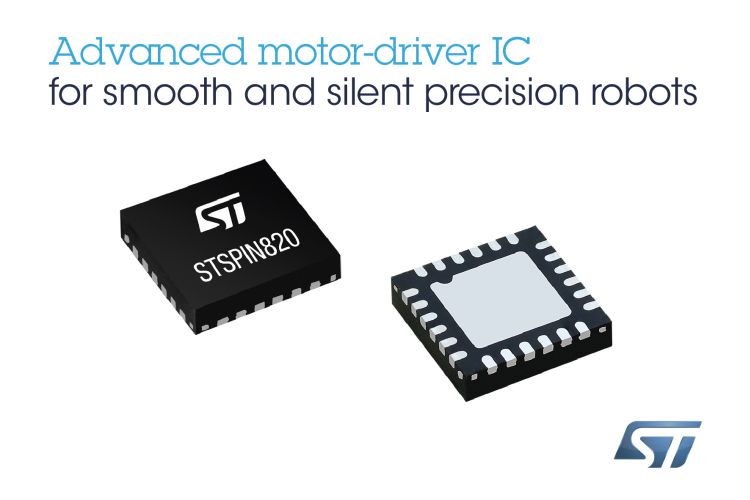
ST’s STSPIN820 IC enables the next generations of stepper-motor-based robots to achieve even greater smoothness and silence, with smaller size, greater precision, and lower power consumption. With its high-speed inputs and precise micro-stepping algorithm, it can turn a motor by a fraction of a degree to move a 3D printer’s head at a speed of more than 500mm/s, with submicron precision to create parts very quickly and with incredible surface finish, or control extremely precise movements like sample loading, capping/decapping, and storage/retrieval in next-generation clinical automation systems. Other motor-driven medical equipment such as plate handlers, fluid pumps, blood analyzers, and respirators can be quieter, more compact, and cost-effective.
Measuring just 4mm x 4mm, and containing both the control intelligence and fully protected power components (rated 45V and 500mΩ RDS(ON)) for driving the motor, the chip is the world’s smallest all-in-one high-precision controller. Manufacturers of automation equipment can simply place the device on the controller circuit board, with minimal extra parts needed to complete the system, to save space and enhance system reliability.
Further information can be found at http://www.st.com