• LinkedIn
  • KONTAKT
  • ANNONCERING
  • PARTNERLOGIN

ElektronikFOKUS

Fokus på elektronik

  • Branchenyt
  • Design & udvikling
  • Events
  • IoT & embedded
  • Komponenter & konnektorer
  • Power
  • Produktion
  • Test & mål
  • Wireless & data
  • Artikler fra Aktuel Elektronik

Test & mål04. 02. 2022 | Rolf Sylvester-Hvid

European Space Agency uses Yokogawa instruments to achieve precise laser tuning for satellites

Test & mål04. 02. 2022 By Rolf Sylvester-Hvid

The European Space Agency (ESA) is using the precision of Yokogawa’s optical wavelength meters to ensure accurate tuning of lasers used in Earth to space communications.

ESA operates a network of geostationary satellites known as the European Data Relay System (EDRS). These satellites communicate with a constellation of European Low Earth Orbit (LEO) satellites called Sentinels, used for Earth monitoring applications.
The AQ6151B also has built-in analysis functions and requires no programming, making it easy to use.

The EDRS satellites use radio communication to upload the LEO satellites’ images and other data to terrestrial servers.

The challenge is that the growing amount of information from LEO and geostationary satellites and from satellite constellations will mean that the available bandwidth from radio communication links will soon be too low to meet ESA’s data transfer needs.

Optical, laser-based communication is the obvious answer, a technique already used to transfer data between the LEO satellites and the EDRS network. Optical communications is a proven technology on Earth and forms the backbone of the internet.

However, optical communications in free space between the Earth and a satellite calls for special laser technology. This is because optical signals transmitted between the Earth and space are subject to interference from various sources, such as clouds or other weather phenomena.

In addition, optical signals in free space cannot be shielded from external sources of optical interference by the physical medium through which they travel, such as an optical fibre on Earth.

Optical communication systems need to achieve a sufficient signal-to-noise ratio to maintain the link between transmitter and receiver. In the ESA’s EDRS, signals are transmitted at a very precisely specified infrared wavelength of 1064.625 nm (nanometers) ±11 pm (picometers), with almost zero variance in the peak wavelength. This allows the receiver to lock on to the transmitted narrowband signal and to eliminate interfering signals. With this technology, the EDRS satellite can operate even when the sun is in its line of sight.

ESA is implementing optical Earth-to-satellite communications technology in its optical ground station (OGS) on the Spanish island of Tenerife and at the Aristarchos 2.2 m telescope at the Chelmos observatory in the Peloponnese in Greece.

Maintaining the exact transmitter wavelength is a critical part of the Aristarchos system’s operation, achieved by a technique where the transmitter laser is pumped by an 808nm laser diode to generate an accurate 1064.625 nm ±11 pm output. This wavelength is controlled accurately by adjusting the operating temperature of the transmitter laser.

Measurement of optical communications systems is usually performed using an optical spectrum analyzer (OSA), a highly accurate and reliable instrument that analyzes optical wavelength, among other criteria.

OSAs such as Yokogawa’s AQ6370D achieve a wavelength measurement accuracy of ±10 pm (picometres) at a reference wavelength of 1550 nm and ±100 pm at 1064.625 nm. Although this is highly accurate, it is still not accurate enough to meet the demands of the Aristarchos installation.

Zoran Sodnik is the optical communications technology manager at the ESA’s telecommunications and integrated applications directorate. He is responsible for the optical communications system installed with the Aristarchos telescope. Says Sodnik: ‘The EDRS operates at frequencies measured in multiples of terahertz and the transmitter and receiver wavelengths are no more than 28 Gigahertz apart. This means that the laser’s frequency has to be set with Gigahertz precision, and then measured with the same level of precision and accuracy.’

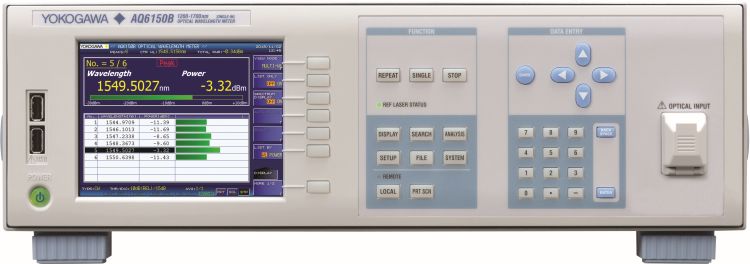
Working with Simac Electronics, a Netherlands-based supplier of connectivity and measurement technologies, the ESA selected a specialist optical wavelength meter, the AQ6151B from Yokogawa.

The instrument uses a Michelson interferometer, capable of measuring wavelength very accurately.  In the AQ6151B, the high accuracy model in the AQ6150 Series, accuracy is specified at ±0.2 ppm. Available in three wavelength ranges, the Aristarchos installation uses the Wide Range version, covering wavelengths from 900 nm to 1700 nm.

The AQ6150 series offers high speed, with the ability to acquire, analyze and transfer a measurement to a PC within 0.2 seconds. As well as high accuracy, the AQ6150 Series offers simultaneous measurement of up to 1024 wavelengths and handles input signal power as low as -40 dBm.

The AQ6151B also has built-in analysis functions and requires no programming, making it easy to use.

Sodnik was confident that using the Yokogawa optical wavelength meter would produce the results that the ESA was looking for: ‘The ESA has used Yokogawa instruments extensively in the past and has always found them to be extremely accurate and reliable. This latest installation at the Chelmos observatory called for extremely high accuracy. I had no hesitation in selecting a Yokogawa product – it has fully lived up to my expectations.’

Using the highly accurate AQ6151B to tune lasers, ESA expects that optical transmission could take on the burden of handling high bandwidth traffic, replacing radio communication as the primary means of sending and receiving data from satellites.

Read the full case study here: https://info.eu.tmi.yokogawa.com/acton/fs/blocks/showLandingPage/a/19192/p/p-010e/t/page/fm/0
Skrevet i: Test & mål

Seneste nyt fra redaktionen

Tør vi være afhængige af amerikanske systemer til cybersikkerhed og positionering?

BranchenytTopWireless & data07. 01. 2026

Donald Trump og hans regering sidder for tiden udmeldinger fra de store NATO-medlemslande og andre globale organisationer om Folkeretten og vestlige alliancer stærkt overhørigt, og det er en kilde til både frustration og bekymring. Vi har længe - med rette - i Europa kæmpet mod russiske hackere og

Finske Upcloud har åbnet nyt datacenter i København

Wireless & data07. 01. 2026

Den finske cloud-udbyder Upcloud har åbnet sit nyeste datacenter i København. Åbningen er svar på stigende efterspørgsel blandt europæiske virksomheder på, at virksomheders data forbliver i Europa og kun er underlagt europæisk lovgivning. Med det nye datacenter har UpCloud nu i alt ni lokationer i

TDK lancerer strømbesparende STRIDE- realtidspositionerings-SW til wearables og IoT

IoT & embedded07. 01. 2026

TDK Corporation annoncerer Trusted Positioning STRIDE, en indlejret Pedestrian Dead Reckoning (PDR) softwareløsning, der er specielt udviklet til wearables - herunder smartwatches, hovedmonterede enheder, briller og kompakte sensorer. I takt med at OEM'er presser på for mere intelligente,

STMicroelectronics skalerer STM32-mikroprocessorer for fleksibel ydelse

IoT & embedded07. 01. 2026

STMicroelectronics har introduceret STM32MP21-mikroprocessorer (MPU'er) til omkostningsbevidste edge-applikationer i smarte fabrikker, smarte hjem og smarte byer med en kombination af avancerede kerner og periferiudstyr med stærk sikkerhed målrettet SESIP Level 3 og PCI-certificering. De nye

Første “eMC” med solid-state batterier

Power07. 01. 2026

Ved at bruge solid-state-batteriteknologi i sine motorcykler vil eMC-producenten, Verge, muliggøre opladning på ti minutter og en rækkevidde på op til 500 kilometer. Ifølge virksomheden er det et teknologisk gennembrud, der endelig bliver lanceret på offentlige veje, forlyder det på vores norske

SDU etablerer avanceret AI-datacenter sammen med Danfoss og HPE

AktueltBranchenytPowerWireless & data07. 01. 2026

Det nye datacenter bygger videre på SDU eScience Centers erfaring med udvikling af innovative cloud-teknologier og levering af nationale tjenester inden for højtydende computing (HPC), herunder DeiC Interactive HPC, baseret på UCloud, som siden 2019 har leveret supercomputerressourcer til danske

3D-printet løsning reducerer energiforbruget til køling i datacentre markant

AktueltDesign & udvikling07. 01. 2026

Datacentre står over for en voksende udfordring med stigende energiforbrug til køling af servere og GPU'er. Et europæisk forskningsprojekt har nu demonstreret en ny køleløsning, der reducerer energiforbruget betydeligt og forlænger levetiden på computerchips – og så muliggør løsningen genanvendelse

Nyt år og nye udfordringer

BranchenytTop05. 01. 2026

Allerførst et rigtig Godt Nytår til alle vore tusindvis af læsere derude i det vinterkolde Danmark - og andre steder på planeten for den sags skyld. Tømmermændene fra nytårsaften har dårligt nok lagt sig, før de politiske hovedpiner begynder at dukke op: Beklageligvis er det ikke Verdens

Kontinuerlig analyse af sved på huden i realtid

Design & udvikling05. 01. 2026

På dansk ved Jørgen Sarlvit Larsen Franske CEA-Leti har i samarbejde med STMicroelectronics annonceret et praktisk system til kontinuerlig analyse af sved i realtid med en sensorpude placeret direkte på huden. Systemet kombinerer ST's nye, højpræcise analoge solid-state elektrokemiske sensorer

EU-projekt skal gøre grøn energi billigere og mere effektiv

Design & udviklingPower05. 01. 2026

Over de næste fire år skal det europæiske forskningsprojekt ACTNXT udvikle avanceret udstyr, der gør store forskningsfaciliteter bedre til at hjælpe Power-to-X-industrien med at udvikle fremtidens grønne energiløsninger. Projektet ledes af Teknologisk Institut. En tredjedel af verdens

Tilmeld Nyhedsbrev

Tilmeld dig til dit online branchemagasin/avis


Aktuel Elektronik - underleverandøroversigt
Få fuld adgang til indlægning af egne pressemeddelelser… Læs mere her

/Nyheder

  • ACTEC A/S

    Når batteriet bliver en del af løsningen – ikke en begrænsning

  • Silitrade ApS

    New partner

  • Mouser Electronics

    The Latest News from Mouser Electronics

  • Eltraco Automation

    Her er Eltracos bud på tendenser i 2026

  • GOmeasure ApS

    Glædelig jul og godt nytår

  • Mouser Electronics

    Mouser Electronics Signs Global Distribution Agreement with Telit Cinterion for Enterprise-Grade IoT Solutions

  • Elektronikmessen

    Glædelig jul fra Elektronikmessen!

  • Mouser Electronics

    Mouser Electronics Highlights Energy-Efficient Designs With Power Management Resource Centre

  • InnoFour

    6 reasons why Jira users will love Polarion

  • Mouser Electronics

    The Latest News from Mouser Electronics

Vis alle nyheder fra vores FOKUSpartnere ›

Seneste Nyheder

  • Tør vi være afhængige af amerikanske systemer til cybersikkerhed og positionering?

    07.01.2026

  • Finske Upcloud har åbnet nyt datacenter i København

    07.01.2026

  • TDK lancerer strømbesparende STRIDE- realtidspositionerings-SW til wearables og IoT

    07.01.2026

  • STMicroelectronics skalerer STM32-mikroprocessorer for fleksibel ydelse

    07.01.2026

  • Første “eMC” med solid-state batterier

    07.01.2026

  • SDU etablerer avanceret AI-datacenter sammen med Danfoss og HPE

    07.01.2026

  • 3D-printet løsning reducerer energiforbruget til køling i datacentre markant

    07.01.2026

  • Nyt år og nye udfordringer

    05.01.2026

  • Kontinuerlig analyse af sved på huden i realtid

    05.01.2026

  • EU-projekt skal gøre grøn energi billigere og mere effektiv

    05.01.2026

Alle nyheder ›

Læs Aktuel Elektronik

Aktuel Elektronik avisforside

Annoncér i Aktuel Elektronik

Medieinformation

KONTAKT

TechMedia A/S
Naverland 35
DK - 2600 Glostrup
www.techmedia.dk
Telefon: +45 43 24 26 28
E-mail: info@techmedia.dk
Privatlivspolitik
Cookiepolitik