The cooperation between the e-mobility specialists of Rutronik‘s Automotive Business Unit (ABU) and Vishay‘s Automotive Division realised a new reference design for a high-voltage (HV) circuit breaker with a maximum breaking capacity of 40 kW. This replaces previous options that used mechanical relays with an intelligent, resettable and low-loss semiconductor solution. HV switches are an indispensable link within an HV architecture of modern Battery Electric Vehicles (BEV). They are used to safely and unambiguously separate auxiliary units from the rest of the vehicle‘s electrical architecture on the high-voltage side (400/800V side) – depending on the platform architecture – and thus prevent major damage.
Next-generation electric vehicles will have up to three different voltage levels:
• A 12V electrical system for small actuators and all control units
• A 48V electrical system for larger power consumers such as water pumps, EPS or radiator fans
• A 400 to 800V electrical system containing the battery pack and the largest consumers such as the inverter, the high-voltage heater, the OBC, the HV/LV DCDC and the HVAC.
Especially the latter requires a maximum of safety and reliability for all installed components.
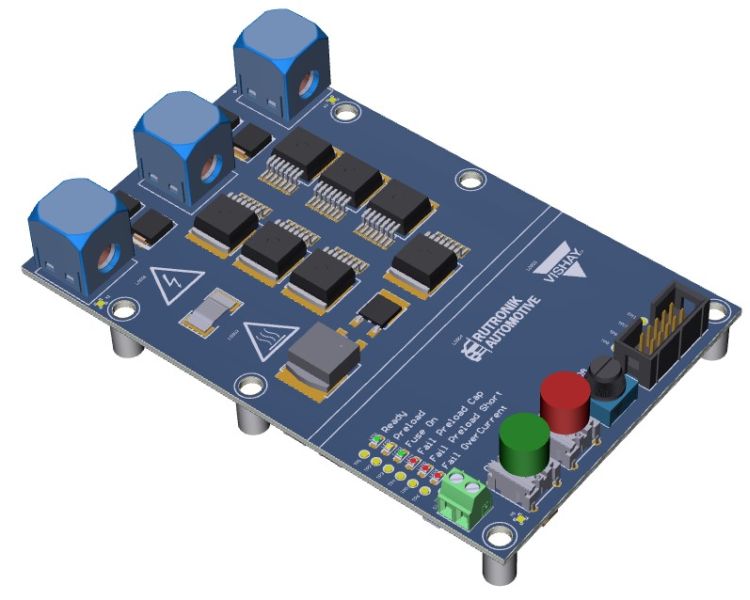
In terms of circuitry, the HV disconnector consists of an isolated 800V power stage with 12V measurement and evaluation electronics and an AURIX TC375 Lite Kit. The concept of the HV isolator switch is realised in the switching stage with high-performance semiconductors of the latest SiC generation from ROHM, galvanic isolation of the measuring channels, high-precision shunts, new optocouplers and all protective components from Vishay. In addition, a second-generation AURIX microcontroller from Infineon controls the device.
With the 1200V SiC MOSFETs of the fourth generation in SMD housing and a precisely tuned control via a SiC gate driver, the HV disconnector is able to switch powers of up to 40kW. The resulting power loss reaches approx. 16W. The resulting heat can be passively dissipated at room temperature (25°C). Thus, the new innovative concept exceeds the requirements of premium OEMs.
The HV disconnector has a pre-charge path with which capacitive loads can be precharged via a SiC MOSFET, a pre-charge resistor and two implemented pre-charge modes (13ms or 130ms), thus preventing overcurrent at switch-on. A galvanically isolated SiC driver drives the main MOSFETs. The pre-charge MOSFET is controlled via a galvanically isolated phototransistor. The maximum load current of the disconnector can be set either via the microcontroller or individually via a potentiometer in stand-alone mode. With the 1200V SiC MOSFETs of the fourth generation in SMD housing and a precisely tuned control via a SiC gate driver, the HV disconnector is able to switch powers of up to 40kW. The resulting power loss reaches approx. 16W. The resulting heat can be passively dissipated at room temperature (25°C). Thus, the new innovative concept exceeds the requirements of premium OEMs.
The Powerstage features high-precision shunts from Vishay, which are characterised by their extremely accurate bi-directional measurement of the battery current. The current and voltage measurement signals are transmitted galvanically isolated (floating measurement), processed by measurement signal amplifiers and passed on to the microcontroller. The newly developed VOA300 linear optocouplers from Vishay provide galvanic isolation from the 12V side. Two series-connected highvoltage MLCCs from Vishay provide the galvanically isolated supply of the op-amps.
This supply includes a push-pull driver stage with 50 kHz. The AURIX board is connected via a cable connection and, after successful connection, can output the processed measured values via an already implemented software. The configuration and readout of measured values of the eFuse with AURIX control is done via an existing CAN interface.
In addition to the precise current and voltage measurements, the concept also has a diagnostic function and further protective measures, such as over-current detection with adjustable threshold, in- & output transient protection as well as additional TVS diodes for power supply protection. The input and output voltage is monitored via ratiometric thresholds, which thus also enables use for 400V systems. In addition, the reference design has a status display with LEDs as well as two push buttons for manual control. Equipped with a housing that allows access to all measuring points, protection against accidental contact is also guaranteed.
Since its foundation in 2014, the Automotive Business Unit (ABU) has focused on strategic topics in the vertical market segment of automotive. The ABU supports companies not only in mastering the transformation in the automotive market, but also in profiting from it. The central focus is on modern and economical concepts for the mobility of tomorrow.